Trieste, the Netherlands, the United States · 1940 to 1965
The Ourang Medan
Did a Dutch freighter named Ourang Medan lose her whole crew to an unexplained death in the Strait of Malacca in 1947 or 1948, and if not, who made the story up?
What happened. In the version told today, a Dutch freighter called the Ourang Medan sent a distress call from the Strait of Malacca, the sea lane between Malaya and Sumatra, in February 1948: the officers were dead, the crew probably dead too, and the last words were "I die". An American ship, the Silver Star, found her drifting and put a boarding party aboard, who found the crew dead on their backs with faces turned up and mouths open, and even the ship's dog dead. Smoke rose from a hold, the boarding party fled, and the ship exploded and sank. Explanations offered since then range from fumes from a cargo of potassium cyanide and nitroglycerine to carbon monoxide, nerve gas and "something from the unknown".
Why it is a mystery. No port of registry, owner, rescue log or inquiry has ever been produced for the ship, and no ship of the name is in any list of the world's merchant ships. Those who think something real happened point to where the story appeared: the United States Coast Guard printed it in 1952 in its own safety magazine for merchant seamen, Proceedings of the Merchant Marine Council; a letter about it lies in the CIA's declassified files; The American Weekly, the Sunday magazine of the Hearst newspapers, claimed in 1948 that its research showed the tragedy had happened; and popular accounts from the American broadcaster Frank Edwards (1956) to the British writer Roy Bainton (1999) present it as a documented event. The sceptics, among them the blogger Estelle Hargraves (2015), Brian Dunning's Skeptoid podcast (2020) and the Dutch researcher Theo Paijmans (2021), answer that the Coast Guard item names no source, that the "CIA memo" is a private citizen's letter, and that Paijmans, writing in Fortean Times, the British magazine of strange phenomena, traced the tale to an Italian newspaper of 1940, where it is dated 1939 and set in the South Pacific. Even the sceptics had checked Lloyd's Register, the annual list of the world's merchant ships, by enquiry rather than by reading the volumes, and little was known of the Italian author.
How it was judged. Every printing of the story was read in the order it appeared, from the earliest known, a signed article in the Trieste evening paper Il Piccolo delle Ore Diciotto (Il Piccolo) of 16 October 1940, through reprints in nine countries to the books of the 1950s and 1960s, with every quoted passage transcribed from the page image and transcribed again blind (without sight of the first transcription) as a check. The scanned volumes of Lloyd's Register for 1938/39 to 1950, its quarterly returns of ships lost (the Wreck Returns) for 1946 to 1949, the Dutch fleet databases and the Singapore press were searched in full text; the author was traced through official gazettes, city directories, civil registers and his own letters; and each detail of the modern story was dated to the printing that introduced it. What came out is that the story was written by one man, Silvio Scherli, a ship's radio officer and freelance journalist of Trieste, the Italian port at the head of the Adriatic: he published it in 1940 as an event of 1939 off the Solomon Islands, added a sequel with a sole survivor in 1941, and in 1948 sold both, re-dated to 1947, to the Dutch weekly Elsevier's Weekblad, whose editors printed a note that they had nothing beyond his personal assurance; the Strait of Malacca, the date February 1948 and the Silver Star were added later by American and German writers. What tipped the balance was the texts, the author's shifting dates, places, finders and casualty counts, the re-used photographs and the absence of any independent report, with the registers adding only that no ship of that name existed; the verdict is fabricated, invented outright about 85 percent, a real incident under another name about 14 percent, genuine as told below 1 percent, and an entry in a register or in a return of ships lost, a contemporary news report or a rescue log would overturn it.
Verdict
Fabricated: the story was written by Silvio Scherli in Trieste in 1940 and published as fact. Invented outright about 85%; a real incident under another name, altered beyond recognition, about 14%; genuine as told below 1%.
The story's growth is traced printing by printing from dated texts: the key ones are reproduced as page images, the rest are marked as reported or as search snippets, and every quoted passage was transcribed a second time blind against the images. The registers rule out the ship as described and cannot rule out a real incident under another name; the percentages are judgments.
The percentages are judgments. Confidence that the story as told, in any of its dated versions (November 1939, June 1947, February 1948), records the loss of a real ship is below 1 percent: a named steamer with a crew of forty would stand in Lloyd's Register and its Wreck Returns, and none does. The 14 percent is the room left for a real derelict or shipboard poisoning, under another name, that Scherli heard of at sea and altered beyond recognition. Register searches cannot close that residual, because the digitised volumes are incomplete for the war years and a kernel (a real event behind the story) need not have been a total loss at all. The texts are what bound it: the story's structure is the Mary Celeste pattern of sea fiction (the Mary Celeste was found under sail with no one aboard in 1872), the author wrote a whole series of such dramas as reportage, he re-used the same photographs for events eight years apart, and nothing in any version has ever been matched to a documented incident.
The split between "invented" and "a real incident under another name" weighs those textual points against the one consideration on the other side, that the author was a working ship's radio officer. A reader who weighs that more heavily could put the residual at a quarter without changing the first line.
The best argument for a real kernel is the man himself, since no document supports it. The technical texture of his story is a radio man's (the 600-metre distress band, the wavelength reserved for distress calls; the request to relay by short wave; the medical-advice service; the auxiliary transmitter), and a seaman-journalist might have heard, in a mess room, of a derelict with a poisoned crew and built the tale on it. Against this: no version names a rescuing ship that can be traced, her master, a port, an owner or a casualty number; the one finder that is named, the American torpedo boat "W 716" of the 1940 article, did not exist; his own 1948 sequel pre-empts the register check by having the survivor explain that ships of this kind "are no longer listed in Lloyd's Register", an explanation that is no evidence of an event; the same two photographs serve for events eight years apart; and between his own three versions the author moved the SOS from 13 to 19 November, the explosion from hatch two to hold four, the ship from Australian to Dutch ownership and the dead from twelve to twenty-two.
The shares are judgments, and the third is below 1 percent. They weigh the textual evidence (three versions by the author that contradict one another, photographs re-used for events eight years apart, no independent report in any archive) against the one consideration on the other side, that Scherli was a working ship's radio officer. A reader who weighs that more heavily could put the residual for a real incident under another name at a quarter without changing the first line.
What was done
Every printing of the story was read in the order it appeared, from the earliest known, a signed article in the Trieste evening paper Il Piccolo delle Ore Diciotto of 16 October 1940 by Silvio Scherli, a ship's radio officer and freelance journalist, through reprints in nine countries to the books of the 1950s and 1960s, with every quoted passage transcribed from the page image and transcribed again blind, without sight of the first transcription, as a check. The key printings are reproduced as page images; the rest are marked as reported or as search snippets and attributed to the investigator who saw them.
Some archives could not be searched: Trove, the Australian newspaper archive, and the Fiji Times for 1939 to 1941; the Austrian National Library's ANNO viewer, the British Newspaper Archive and Gallica's full-text pages, which are gated, so that the Vienna and Karlsruhe printings of October 1940 are known from Theo Paijmans, the Dutch researcher who traced the tale to Trieste in 2021; and the Dutch weekly Elsevier's Weekblad, which printed the story in January 1948 re-dated to June 1947, and the weekly Panorama, which are not digitised. The Lloyd's Register volumes for 1940 and 1943 to 1946 are not online.
Three further checks were made. The scanned volumes of Lloyd's Register, the annual list of the world's merchant ships, for 1938/39 to 1950, its quarterly returns of ships lost (the Wreck Returns) for 1946 to 1949, the Dutch fleet databases and the Singapore press were searched in full text for the ship under every spelling. The author was traced through official gazettes, city directories, civil registers and his own letters. And each detail of the modern story was dated to the printing that introduced it: the Strait of Malacca, the date February 1948 and the rescue ship Silver Star were added later by American and German writers.
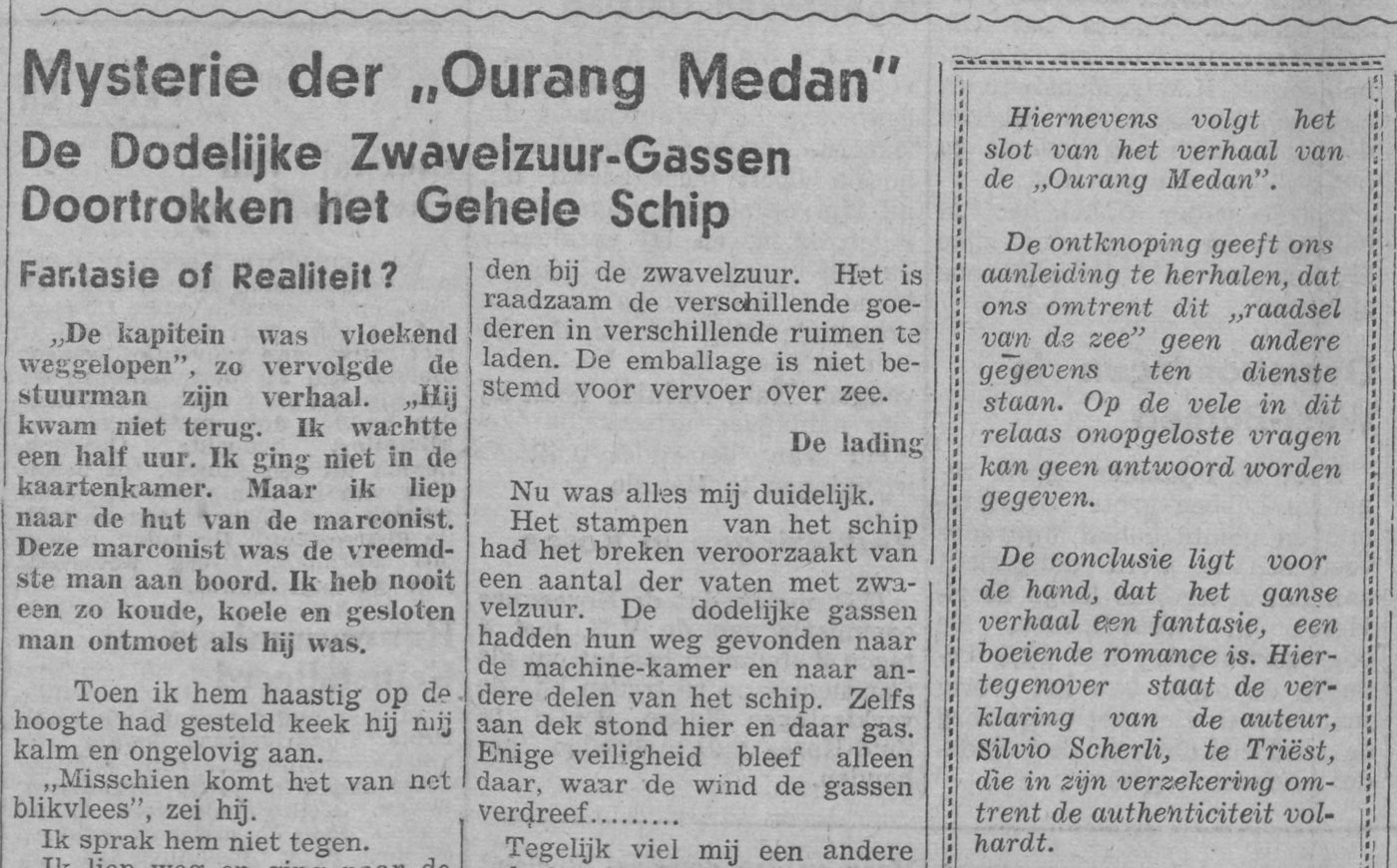
Figure 1 is the headline of the earliest printing known, Scherli's article in Il Piccolo of 16 October 1940, describing a disaster of "last November", 1939, in the South Pacific. Figure 2 is the final instalment of 13 March 1948 in De locomotief, the Semarang daily that reprinted the serial: under the sub-heading "Fantasie of Realiteit?" the editors, who had printed that they had nothing but the author's word, concluded that the obvious reading was fiction. Figure 3 is the entry in Lloyd's Register for 1947 for the Santa Juana, formerly the Silver Star: the only Silver Star had lost the name before the Register went to press in mid-1947.
What tipped the balance was the texts: the author's shifting dates, places, finders and casualty counts, the photographs re-used for events eight years apart, and the absence of any independent report; the registers add only that no ship of that name existed. Hence fabricated: invented outright about 85 in 100, a real incident under another name about 14, genuine as told below 1. The percentages are judgments, and the 14 is the room left for a real derelict or shipboard poisoning heard of at sea; an entry in a register or a return of ships lost, a contemporary news report or a rescue log would overturn the verdict.


What is new here
- The Trieste texts in full: the article of 16 October 1940, the editors' note of 26 October 1940 announcing the story's reprinting abroad (the syndication note) and the sequel of 5 February 1941, read as page images from the newspaper's own digital archive and transcribed. Paijmans had a library copy of the first and quoted its rescue boat; the sequel had been listed by the anonymous 2024 blog on Scherli but not, so far as can be found, read. It shows that the sole survivor, the departure from Singapore, the falsified cargo, the nitroglycerine and cyanide, hold no. 4 and the rats are Scherli's own inventions of February 1941 rather than additions of 1948 or later, and that his three versions disagree on the date of the SOS, the ship's nationality, the exploding hold and the size of the cargo.
- Scherli in the records: the decree of 1930 that changed his surname from Scherk to Scherli, with his birth date, parentage and address; the 1933 travel photography; the editors' 1940 reply to a doubting reader; the 1943 marriage and the civil-register entry giving his trade as merchant-navy radio officer; the 1950 report from Gijón, a Spanish port; the 1952 city directory; the 1954 letters to the American Tobacco Company; the 1958 photo credit; his death on 7 March 1985. The often-repeated claim that he wrote about the ship again in Export Trade, a New York trade paper, in 1959 rests on a misreading of a trade report on the port of Trieste.
- The earliest open-archive Dutch printing: the Leekster courant, a weekly of Leek in the Dutch province of Groningen, of 24 January 1948 with its explicit credit to Elsevier's Weekblad, and the April 1948 item in the Dutch magazine De schalmei that treats the story as common knowledge; transcriptions of the Leekster and Semarang texts (the reprint in De locomotief, a daily of Semarang on Java in the Netherlands Indies) corrected against the page images. Full-text searches on fifteen distinctive phrases found no other printing of the text in 1947 to 1949 among the papers digitised on Delpher.
- The registers, reproducibly: a volume-by-volume full-text check of seventeen Lloyd's Register volumes (fifteen for 1938/39 to 1950 and the 1930/31 and 1936 steamers volumes as controls) and of the Wreck Returns for 1946 to 1949, with page images and the scripts, and the Register entry that fixes the Silver Star as the Santa Cecilia of 1942 of the Grace Line, a New York shipping line, renamed Silver Star in 1946 and Santa Juana by mid-1947. The absence itself was known; the check rules out the ship as described and cannot rule out an incident under another name.
- Logged negative searches: the Singapore and Malayan press for 1940 to 1949, the New Zealand press, the radio bulletins of the ANP, the Dutch national news agency, the Il Piccolo group's titles after February 1941, and the Coast Guard's Proceedings for the year after its editorial, which printed no correction and no letter.
- The accretions dated: each later "fact" tied to the printing that introduced it, in particular the derivation of the Coast Guard editorial of May 1952 from the feature writer Win Brooks's text in The American Weekly of October 1948, argued from shared wording; the observation that its "February 1948" is the month of the Dutch sequels rather than of any event; and the Brazilian magazine Revista da Semana, of Rio de Janeiro, of May 1950, which names Scherli as narrator two years before the Coast Guard printed the story without a source.
Already established by others. Scherli's authorship, the Trieste priority of October 1940 (the Trieste printing being the earliest), the Associated Press (AP) cable of November 1940, the Elsevier's Weekblad printing of January 1948 and its editors' disclaimers were established by Theo Paijmans (Fortean Times 402, 2021), which remains the essential account. Estelle Hargraves (2015), Brian Dunning's Skeptoid (2020) and Paijmans showed that the Coast Guard editorial is unsigned and unsourced, that the "CIA document" is a private citizen's letter to the CIA, and that the Silver Star entered the story through the German pulp writer Otto Mielke's booklet of 1954 and Roy Bainton's article of 1999. The absence of the ship from Lloyd's Register was noted by Bainton and by later writers; that Taongi, the Marshall Islands atoll where the 1948 sequel lands its survivor, is uninhabited and has no mission, and that no torpedo boat "W 716" existed, were shown by Skeptoid and Paijmans.
Where this verdict stands among historians
What historians have said. Sceptical researchers had already traced the tale back to 1940. Estelle Hargraves (2015) published the Associated Press clipping of November 1940; Theo Paijmans (Fortean Times, 2021) established the Trieste priority of October 1940 (the Trieste printing being the earliest), Scherli's authorship and the Elsevier's Weekblad printing of 1948 with its editors' disclaimers; Roy Bainton (1999) had noted the ship's absence from Lloyd's Register; Brian Dunning's Skeptoid (2020) and Paijmans showed that the Coast Guard editorial is unsourced and the "CIA memo" a private citizen's letter. Popular accounts from Frank Edwards (1956) to Bainton (1999) still present a Strait of Malacca mystery of February 1948 backed by the US Coast Guard's magazine of 1952.
The report agrees with the main line of Paijmans's account and overturns nothing; the basic debunking is not new. Its additions strengthen and date that account: the Trieste texts in full, which show the survivor and the chemical cargo to be the author's own inventions of 1941; the author's life from official records; a register check that can be repeated by anyone; and each later "fact" tied to the printing that introduced it, so the version that looks documentary can be taken apart printing by printing.
What would overturn it
- An entry for a vessel named Ourang Medan (or Orang Medan) in any Register Book of Lloyd's Register, the Netherlands or Netherlands-Indies ship registers, the Indonesian registry after 1945, or a Lloyd's casualty return, in any year from 1900 to 1950.
- A contemporary news report, from Batavia, Singapore, Manila, Suva, Honolulu or the Marshall Islands (under US administration in 1947), of a derelict found with a dead crew in November 1939 or June 1947, or of an explosion and loss with about 22 or 40 dead.
- A rescue recorded in the log or the Grace Line file of the Santa Juana ex Silver Star, or of any vessel, for June 1947.
- Scherli's 16 October 1940 text citing a documented source: a named rescue vessel that existed, a port, an owner, a Lloyd's casualty number.
- An Italian, Austrian or German printing before 16 October 1940 not by Scherli, which would at least show that he was retelling rather than inventing.
- None of these has turned up in eighty-six years, and the first two are now searchable by anyone in minutes. The verdict would weaken, though not reverse, if the still-undigitised wartime Registers (1943 to 1946) or the unsearched Australian press showed a vessel or an incident that fits.
Limits
- Australia and Fiji: Trove, the Australian newspaper archive, and the Fiji Times for 1939 to 1941 could not be searched, though Scherli's 1941 sequel makes the ship Australian, bound for a Western Australian port, and lands the survivor in Fiji. An Australian-registered Ourang Medan, had one existed, would nonetheless be in Lloyd's Register, which lists every Commonwealth vessel over 100 tons, and no such entry exists.
- Trieste: the three Ourang-Medan pages of Il Piccolo and a dozen other issues were read; the rest of "I drammi del mare", Scherli's series of sea dramas in the paper, and his 1950 "Bruciatutto" pieces, a later sea story, are reported from the anonymous 2024 blog and from the archive's text layer (the machine-read text behind the scan) rather than read from the page. The historical archive of the newspaper La Stampa, the Rome and Milan national libraries' newspaper portals and Google Books could not be searched.
- Austria, France, Britain: the Austrian National Library's ANNO viewer, the British Newspaper Archive and Gallica's full-text pages are gated (closed to search without an account); the Vienna and Karlsruhe printings of October 1940 are known from Paijmans, the Yorkshire Evening Post, a Leeds evening paper, from clipping images, the two items in 7 Jours, a Lyon weekly, from Gallica's search snippets.
- The Netherlands: Elsevier's Weekblad and the Dutch weekly Panorama are not digitised; the Elsevier text is known from the Leekster and Semarang reprints and from Paijmans. Mielke's 1954 booklet and Robert V. Hulse's 1953 article in Fate, the American magazine of the paranormal, were not seen.
- Registers: the steamers-and-motorships volumes of Lloyd's Register for 1940 and for 1943 to 1946 are not online, nor is the 1942 sailing-vessels volume. A vessel that entered and left the Register only in those years would be missed by the Register check, though not by the 1946 to 1949 Wreck Returns or by the 1947 and 1948 volumes, which carry every ship afloat. Registry absence shows only that no ship of that name existed; an incident under another name cannot be excluded by searches, which is why 14 percent stays with that reading.
- Scherli: the crew lists on Ancestry, the genealogy site, the Trieste civil registers and any literary estate were not consulted; the crew-list career is reported from the 2024 blog and Skeptoid. The 1930 decree spells him "Scherk"; the identification is very probable rather than proven.
- No paywall or bot gate (a block on automated visitors) was bypassed. Where a source could not be opened it is marked "reported" and attributed to the investigator who saw it.