Meriwether Lewis · Natchez Trace · 11 October 1809
Meriwether Lewis died in the night of 10 to 11 October 1809 at a log inn on the Natchez Trace, shot twice. This page weighs suicide, murder and accident against every document that survives.
On the evening of 10 October 1809 a rider in a loose white gown striped with blue came up alone to two log cabins in the woods of what is now Lewis County, Tennessee, about 72 miles south-west of Nashville, and asked for a night's lodging. The place was Grinder's Stand, one of the settlers' cabins that took in travellers along the Natchez Trace, the old road that ran north-east from the Mississippi through the Chickasaw country to Nashville. The rider was Meriwether Lewis, who had led the Lewis and Clark expedition. As an army captain he had commanded, with William Clark, the expedition that crossed the continent to the Pacific and back in 1804 to 1806. Before that he had been private secretary to President Thomas Jefferson, who planned the expedition and remained his patron. In 1807 Jefferson had made him governor of the Louisiana Territory, the northern part of the land bought from France in 1803, governed from St. Louis. He was 35 years old and on his way to Washington.
His affairs in St. Louis had gone badly by the summer of 1809. Jefferson had left office in March 1809, and in July the War Department under the new president, James Madison, refused to pay some of the bills Lewis had drawn on the government for public spending as governor. The refusal, once known in St. Louis, brought his private creditors down on him. He was at open odds with his deputy, the territorial secretary Frederick Bates. The book of the expedition, which he had promised to write, was three years overdue. He set out on 4 September to defend his accounts in person, carrying the expedition's journals and duplicates of his vouchers, and went down the Mississippi by boat, ill with fever. At Fort Pickering, the army post on the Chickasaw Bluffs where Memphis now stands, the commander, Captain Gilbert Russell, found him deranged and kept him there a fortnight, until he seemed recovered. Lewis then took to the road with James Neelly, the United States government's agent to the Chickasaw nation, through whose land the Trace ran; with his own servant, John Pernier, a man Jefferson had known for six years; and with Neelly's servant. Two days before Grinder's Stand, two of the horses strayed in the night, and Neelly stayed behind to find them while Lewis rode on with the two servants.
The man of the house, Robert Grinder, was away. His wife, Priscilla Grinder, gave Lewis the main cabin and took her children to the kitchen cabin. The servants slept in the stable, some distance off. As Mrs Grinder later told it, Lewis ate little, paced the yard talking to himself, flushed with anger and then turned courteous ("Madam this is a very pleasant evening"), asked his servant for his gunpowder, refused a bed and lay down on the floor on bearskins and a buffalo robe. In the night she heard a pistol shot, something heavy falling, the words "O Lord!", and then a second shot. Lewis came to her door and asked for water, and she was too frightened to answer. When the servants reached him, he told them he had shot himself and asked again for water. He had been shot in the head and in the body, and by some accounts cut with a razor. He was alive at sunrise and dead soon after. Neelly came up later that day and buried him near the stand.
Neelly wrote to Jefferson from Nashville a week later that the governor had killed himself in a fit of derangement. Jefferson accepted the report, and so did William Clark, Lewis's partner in command on the expedition and now the government's Indian agent at St. Louis, whose first words on reading a newspaper report were "I fear this report has too much truth". The Nashville, St. Louis and Washington newspapers printed the death as suicide. No doctor saw the body and no inquest was held.
None of the people who wrote about the night was in the room. Everything comes from Mrs Grinder, who told her story at least four times over 36 years and told it differently each time, and from two servants whose words survive only as others reported them. No one recorded the things that would settle a shooting now: powder marks, the position of the pistols, the state of his hands. The head wound is described in five incompatible ways by five writers who had it at second hand.
The case for suicide was made by the people who knew him. Jefferson wrote in 1813 that Lewis had been "subject to hypocondriac affections" from early life; the word then meant depression. Russell said the boat crew had reported two attempts on his own life on the river, and a letter written at Nashville thirteen days before the death says the same. Neelly found him "at times deranged in mind" on the road. The pressures described above, the protested bills, the quarrel with Bates and the overdue book, were known to all of them. Most historians since have held that view: Dawson Phelps, the National Park Service historian of the Trace, in 1956; Donald Jackson, editor of the expedition's letters, in 1962; and most of the writers who have followed them.
The case for murder began in Tennessee. In 1848 the state legislature appointed a committee to put a monument over the grave, and the committee's report to the legislature of 1849 to 1850 said that death "by the hands of an assassin" seemed "more probable", giving as its grounds the loneliness of the place and a story that the servant had fled with the money and horses. Local tradition accused the innkeeper. The Lewis family accused "his Spanish servant". In 1962 the novelist Vardis Fisher, in Suicide or Murder?, argued that every document was second-hand and every witness interested. Since then the surgeon E. G. Chuinard (1991) has held that Lewis could not have survived and moved as described, and named Neelly as the killer; the historian John Guice (1998 to 2006) has argued that the story never fitted, from the moonless night to the two hours Mrs Grinder waited; the forensic scientist James Starrs and the independent researcher Kira Gale (2009, 2016) have argued for a plot by General James Wilkinson, the army's senior officer and Lewis's predecessor as governor, and have called Russell's statement of 1811 a forgery; and Tony Turnbow, a historian of the Trace, has argued for a robber and a cover story arranged by Neelly. In 1996 a coroner's jury in the county where the grave lies recommended that the body be exhumed; a federal court in 1998 and the Department of the Interior, which manages the grave as part of the Natchez Trace Parkway, in 2010 were asked to allow it, and it has not been opened. Thomas Danisi, Lewis's biographer, holds a third position: Lewis fired the shots in a malarial delirium, and "suicide" is the wrong word for it. At a panel of historians in 2009, two hundred years after the death, the historians put suicide at 96 percent; the audience voted 350 to 20 for murder.
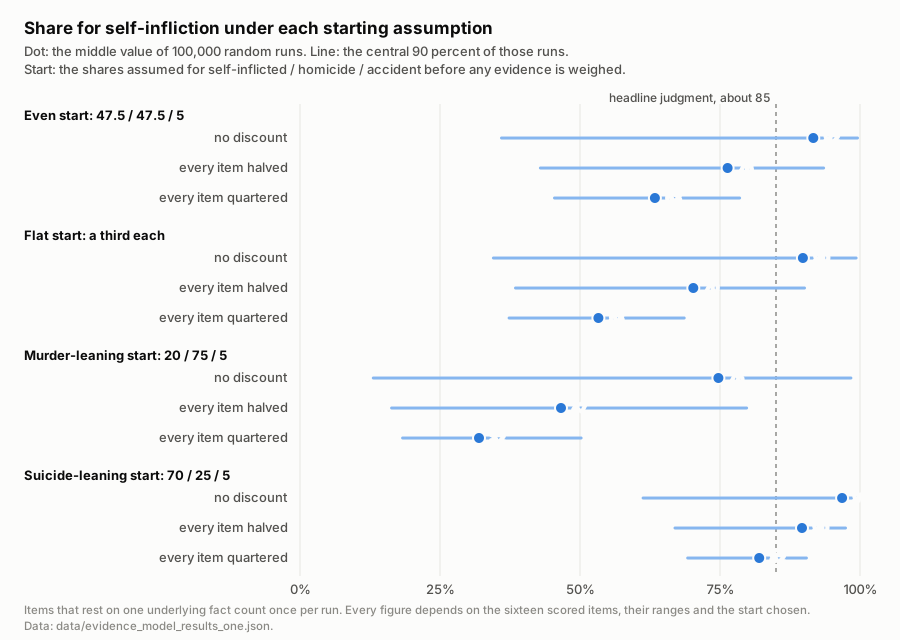
I read every document from 1809 to 1813 that bears on the death, in the editions listed in section 13, and the modern debate from Fisher to 2025, in full where it is published in articles and in fragments where it is in books I could not obtain. I put the events in date order, laid Mrs Grinder's tellings side by side, checked the one claim that she saw something against the phase of the moon, and compared the reported wounds with modern forensic case series of suicides and homicides involving more than one shot. Then I scored sixteen pieces of evidence, each as a range of how much more likely it would be if Lewis shot himself than if someone else did, and combined the scores under several starting assumptions, so that a reader who disagrees with any number can change it and see what follows. The combination puts self-infliction at 92 percent in its central run and at 63 to 76 percent when every item is discounted; a reader who starts from a three-to-one presumption of murder and discounts every item to a quarter ends at 32 percent.
My own figure is about 85 percent for self-inflicted, about 15 for murder and under 1 for accident. It sits below the central run because the model cannot allow for how badly the body was examined: nobody who saw it knew what to look for. The case rests mainly on the month before the death rather than on the night itself, for which there is no reliable witness. Attempts on his own life were reported thirteen days before he died, through chains that do not depend on the one disputed document. The two men who knew him best accepted the news at once. The two men who could have robbed him went straight to his patrons, and his pistols, rifle, watch, horses and two trunks of papers were all accounted for. The reported wound pattern, a head shot that missed the brain, then a shot to the trunk, then hours of survival, is one that suicides with a pistol are documented to produce, and every forensic pathologist who has examined the surgical claim that it is impossible has rejected it. Every murder theory requires at least one of the three people at the stand to have lied about a man the servants found alive and talking, and the conspiracy version requires the record to have been false from a fortnight before he died. Murder keeps about 15 percent for two reasons: the body was never examined for the signs that would decide a shooting, and the model cannot allow for the possibility that the three people at the stand agreed on a false story.
The verdict panel below gives the figures, a table showing how far they move when the starting assumptions change, and a list of what is new here. Section 1 introduces the people and the documents and defines the three possibilities weighed. Section 2 sets out the dated record from Lewis's departure from St. Louis to the last statement by a contemporary, each entry naming its document. Section 3 asks who was in a position to know what. Section 4 lays Mrs Grinder's tellings side by side and tests the one visual claim against the moon. Section 5 covers the wounds, the pistols and what modern forensic series say about such injuries. Section 6 covers Lewis's state of mind: his debts, his illness, the attempts on the boat and the five diagnoses that have been argued. Section 7 takes the homicide theories one by one, each stated in its proponents' words. Section 8 explains the scoring behind the figures. Section 9 answers the strongest opposing writers by name and counts where historians stand. Sections 10 to 13 say what would overturn the verdict, what is new and what agrees with earlier work, what I could not read, and where every document can be found.
Verdict
Lewis shot himself: about 85 percent.
ProbableThe evidence clearly favours one answer over all the others, but does not prove it. The percentage moves when the same evidence is weighed differently.
ConfirmsAgrees with the majority of historians, who hold suicide (Dawson Phelps 1956; Donald Jackson 1962; Paul Russell Cutright 1986; James Holmberg 1992; David Peck 2009; the National Park Service). A minority argues murder, in three versions that exclude one another (section 9). Thomas Danisi, Lewis's biographer, accepts that Lewis fired the shots and rejects the word suicide.
The figure is my judgment. It rests on an explicit weighing of sixteen pieces of evidence (section 8), each entered as a range rather than a point, with the result reported under four starting assumptions and two sceptical settings. The central run gives 92 percent for self-infliction. The sceptical runs, which halve or quarter the weight of every item, give 76 and 63 percent. A reader who starts from a three-to-one presumption of murder and discounts every item to a quarter of its weight ends at 32 percent. I put the headline below the central run for the reason given above: the body was never examined by anyone who knew what to look for, and the model cannot allow for that.
"Self-inflicted" covers two states the record cannot separate: a decision to die, and a delirium in which the same acts were done without one. Both are "suicide" in the sense the 1809 witnesses used the word. The verdict does not depend on which illness lay behind the derangement.
How the result moves (share for self-infliction: the middle value and the central 90% of the model's runs)
| Starting assumption (S / H / A) | Base | Sceptic ½ | Sceptic ¼ |
|---|---|---|---|
| Even, 47.5 / 47.5 / 5 | 92% (36–99) | 76% (43–94) | 63% (45–79) |
| Flat, ⅓ / ⅓ / ⅓ | 90% (35–99) | 70% (39–90) | 53% (37–69) |
| Murder-leaning, 20 / 75 / 5 | 75% (13–98) | 47% (16–80) | 32% (18–50) |
| Suicide-leaning, 70 / 25 / 5 | 97% (61–100) | 90% (67–97) | 82% (69–90) |
Items that rest on one underlying fact or one chain of transmission are counted once in each of the model's 100,000 random runs rather than multiplied together. Multiplying them instead gives 100 percent in every base run, so the grouping matters more than the starting assumption. Leaving out any one item moves the central result by at most 9 points (without "valuables left" it is 83 percent; without the contemporaries' acceptance, 86). Accident, entered as a simple discharge, stays under 1 percent in every base run; the sceptical runs lift it to 2 percent under the even prior and to at most 2.5 percent under the murder-leaning one, and the flat prior (a start in which the three possibilities are equally likely) to 7 and 17 percent under the two sceptical settings. Every figure depends on the sixteen items, their ranges and the starting assumptions chosen, and it summarises judgments rather than measuring anything. Code and data: code/evidence_model.py, data/evidence_items.json, data/evidence_model_results_one.json.
What is new here
Contents
The people who appear in what follows, in roughly the order they enter the story.
The documents most often cited are the letters of Neelly and Brahan to Jefferson of 18 October 1809; the Nashville Democratic Clarion of 20 October, the first newspaper report; the Missouri Gazette of St. Louis and the National Intelligencer of Washington, which printed the news in November; Clark's letters to his brother of 28 October and 26 November; Russell's letters to Jefferson of 4 and 31 January 1810 and his statement of 26 November 1811; Pernier's petition to Jefferson of 10 February 1810; Wilson's letter of 18 May 1810; Jefferson's memoir of 1813; an account of the night that Mrs Grinder gave to a passing stranger, a schoolteacher, about 1839, printed in 1845; and the report, presented in 1849 to 1850, of the committee appointed by the Tennessee legislature in 1848 to put a monument over the grave. Most of the letters are printed in Founders Online, the National Archives' free online edition of the founders' papers, and in The Papers of Thomas Jefferson: Retirement Series, or in Donald Jackson's Letters of the Lewis and Clark Expedition (1962; second edition 1978). Section 13 lists them with their identifiers.
The modern writers who appear most often: Dawson Phelps, the National Park Service historian of the Natchez Trace, whose article of 1956 made the documentary case for suicide; Vardis Fisher, a novelist, whose Suicide or Murder? (1962) opened the case for murder; Paul Russell Cutright, a historian of the expedition (1986); E. G. Chuinard, a surgeon and expedition historian, who argued murder in 1991; James Holmberg of the Filson Historical Society in Louisville, who edited Clark's letters to his brother (1992, 2002); John Guice, a historian at the University of Southern Mississippi, who argued murder between 1998 and 2006; Thomas Danisi, Lewis's biographer, who argues for a self-inflicted death that was not suicide (2002 to 2014); Tom Chalkley, who wrote the fullest study of Pernier (2004); Ann Rogers, on the order of the shots (2005); Michael Carrick, a firearms historian, on the pistols (2006, 2009); James Starrs, a professor of law and forensic science who led the campaign to exhume the body, and Kira Gale, an independent researcher, who argued murder together in 2009, and Gale alone for a Wilkinson conspiracy in 2015 and 2016; David Peck, a physician, on the medical questions (2009, 2022); Clay Jenkinson, on Lewis's character (2011); and Tony Turnbow, a historian of the Trace, on Neelly (2012, 2015). Their works are listed in section 13 and the strongest of them are answered in section 9. We Proceeded On, cited throughout, is the journal of the Lewis and Clark Trail Heritage Foundation, in which most of this debate has been conducted.
Three hypotheses are weighed throughout. Self-inflicted (S): Lewis fired both shots himself, whether by decision or in delirium. Homicide (H): someone else fired at least the fatal shot, whoever it was and whatever the motive. Accident (A): nobody intended the wounds. Homicide is treated as one hypothesis, though its advocates disagree about the killer; section 7 takes their versions separately, and section 8 says how a reader who holds one of them can re-enter the scoring for that case alone. The documents of 1809 to 1813 are quoted in their own words and kept apart from what later writers made of them, and the case for murder is stated in its authors' words before it is answered.
The table gives the dated record from Lewis's departure from St. Louis to the last statement by a contemporary. Every entry names its document. Section 13 lists the documents with their identifiers in Founders Online or their printed source.
| Date | Event | Document and words |
|---|---|---|
| 15 Jul 1809 | The Secretary of War, William Eustis, refuses to honour drafts Lewis drew on the government. | Eustis to Lewis, 15 July 1809 (Carter, Territorial Papers 14:285–86, cited by the Madison Papers editors). Lewis's reply of 18 August: "All I wish is a full and fair Investigation." |
| 4 Sep | Lewis leaves St. Louis by boat for New Orleans and Washington, with Pernier. | Russell's statement of 26 Nov 1811: "left St. Louis late in August, or early in September 1809, intending to go by the route of the Mississippi and the Ocean". |
| 11 Sep | Writes a short will at New Madrid. | Named on the National Park Service's page on his effects, but not found in the correspondence I read. |
| 15 Sep | Lands at Fort Pickering (Chickasaw Bluffs, now Memphis) "in a state of mental derangement". Captain Gilbert Russell detains him and his papers. | Russell 1811: the crew told Russell "that he had made two attempts to Kill himself, in one of which he had nearly succeeded". Russell to Jefferson, 4 Jan 1810: "His situation I tho't rendered it necessary that he should be stoped until he would recover, which I done & in a short time by proper attention a change was perceptible and in about Six days he was perfectly restored in every respect & able to travel." |
| 16 Sep | Lewis writes to President Madison: he will go overland through Tennessee. | Lewis to Madison, 16 Sept 1809: "very much exhausted from the heat of the climate, but having taken medicine feel much better this morning"; fears "the original papers relative to my voyage to the Pacific ocean falling into the hands of the British"; brings "duplicates of my vouchers for public expenditures". |
| c. 18 Sep | Neelly, the Chickasaw agent, arrives at the fort. | Neelly to Jefferson, 18 Oct 1809: "I found the Governor ... in Very bad health". |
| 22 Sep | Lewis writes a lucid business letter to Major Amos Stoddard. | "my indisposition has induced me to change my rout"; asks for $200 Stoddard holds for him; "direct to me at the City of Washington untill the last of December after which I expect I shall be on my return to St. Louis". |
| 28 Sep | Captain James House, at Nashville, reports what Stoddard heard from a man "immediately from the Bluffs". | House to Frederick Bates, 28 Sept 1809 (Bates Papers, Missouri History Museum; quoted by Fisher 1962 p. 87, Danisi 2012, Gale 2016): Lewis "in a state of mental derangement" who "had made several attempts to put an end to his own existence"; Russell keeping "a strict watch over him to prevent his committing violence on himself". Written thirteen days before the death. |
| 28 Sep | Major Amos Stoddard, at Nashville, writes to St. Louis about Lewis's condition at the Bluffs. | Extract printed in the Missouri Gazette, 19 Oct 1809: "Governor Lewis was at that place much indisposed, that he was so for several days previous to his arrival. Capt. Russell received him into his quarters and secured his property ... He was under the hands of the surgeons mate Dr. Smith, but no alteration for the better had taken place when my informant left the bluffs." |
| 29 Sep | Lewis leaves the fort with Neelly, an interpreter, some Chickasaw chiefs, Pernier and Neelly's servant. Russell lends him horses, a saddle and a $99.58 Treasury check. | Russell, 4 Jan 1810: Lewis had "perhaps about two hundred & twenty dollars, of which $99 58/100 was a Treasurers Check on the U.S. branch Bank of Orleans endorsed by me. The horses one saddle and this Check I let him have." |
| c. 2–5 Oct | In the Chickasaw nation Lewis "appeared at times deranged in mind"; two days' rest. | Neelly, 18 Oct 1809. Russell 1811: "in three or four days he was again affected with the same mental disease". |
| c. 9 Oct | Crosses the Tennessee River; camps one day's journey beyond; two horses stray overnight. | Neelly: "we lost two of our horses, I remained behind to hunt them & the Governor proceeded on, with a promise to wait for me at the first houses he Came to that was inhabited by White people". |
| 10 Oct, sunset | Lewis reaches Grinder's Stand alone; the two servants follow. Robert Grinder is away. Mrs Grinder gives him the house and sleeps in the kitchen; the servants sleep in the stable. | Neelly: "no person there but a woman who discovering the governor to be deranged gave him up the house & slept herself in one near it, his Servant and mine Slept in the Stable loft some distance from the other houses". Wilson (from Mrs Grinder, May 1810): arrived "about sun-set, alone" in "a loose gown, white, striped with blue"; asked Pernier for his powder; paced, "talking to himself"; "Madam this is a very pleasant evening"; asked for bearskins and a buffalo robe and slept on the floor. |
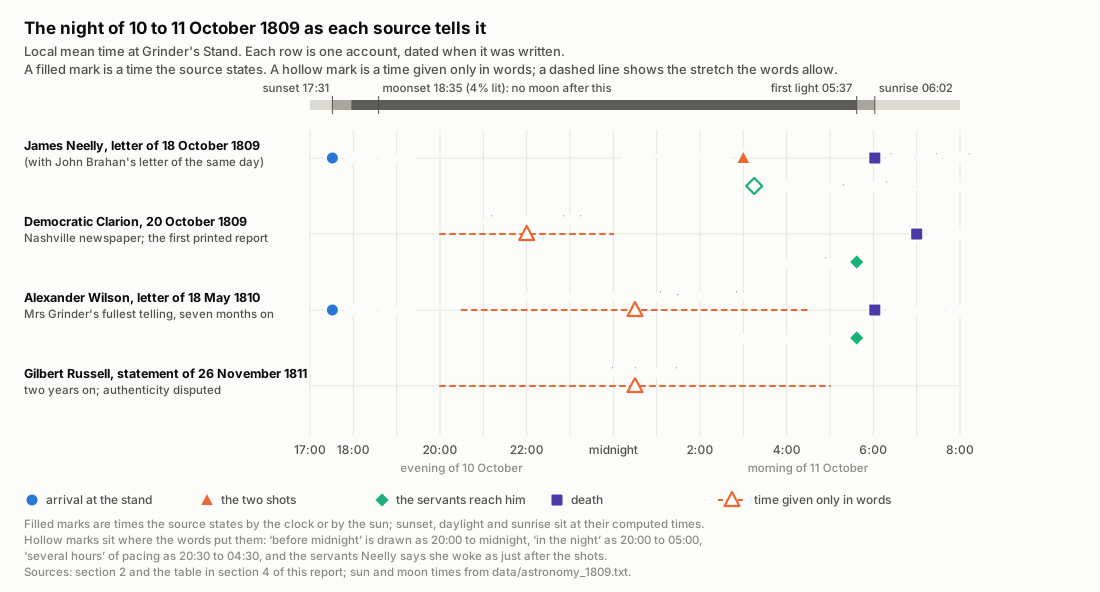
| 11 Oct, c. 3 a.m. | Two pistol shots in Lewis's room. | Neelly: "about three OClock She heard two pistols fire off in the Governors Room". The Clarion of 20 Oct: "some time before midnight". Wilson: "the report of a pistol, and something fall heavily on the floor, and the words 'O Lord!' Immediately afterwards she heard another pistol". |
| 11 Oct, daybreak | The servants find him alive. He says he has shot himself and asks for water. | Neelly: "when his Servant came in he Says; I have done the business my good Servant give me Some water". Clarion: "the governor said he had now done for himself; they asked what, and he said he had shot himself and would die". Wilson: "He often said, 'I am no coward; but I am so strong, so hard to die.'" |
| 11 Oct, sunrise | Death. Neelly arrives later in the day and buries him near the stand. | Brahan: "he lived until Sun rise & expired". Clarion: "expired about seven o'clock in the morning of the 11th". Neelly: "I came up Some time after, & had him as decently Buried as I could in that place". |
| 18 Oct | From Nashville, Neelly and Captain John Brahan each write to Jefferson. Neelly's letter is in Brahan's hand. Neelly lists the effects in his care. | Neelly: "his Rifle, Silver watch, Brace of Pistols, dirk & tomahawk"; two trunks of papers; gave Pernier "fifteen Dollars to Defray his expences to Charlottsville"; Brahan, "fearful that he might be Short of money", gave "five dollars more". Brahan to Jefferson, Eustis and Stoddard, same day. |
| 20 Oct | First printed report, Nashville Democratic Clarion. | As reprinted in the Kentucky Gazette (31 Oct; read from the page images) and the Richmond Enquirer (17 Nov): "had shot a ball that grazed the top of his head, and another through his intestines, and cut his neck, arm and ham with a razor ... He had been under the influence of a deranging malady for about six weeks". |
| 20 Oct | The "Russellville letter": a writer at Russellville, Kentucky, reports what "a gentleman from Nashville" had from "a person who had seen governor MERRIWETHER LEWIS buried". Printed at Lexington on 28 Oct and in the National Intelligencer on 15 Nov. The only contemporary statement of the burial date. | "buried on the 12th inst. about 40 miles beyond Nashville on the Natchez road ... he took his pistols and shot himself twice, and then cut his throat". The Lexington paper adds, from a second informant, that he "shot himself in the head, and cut the arteries in his thighs and arms". On 27 Nov the Intelligencer called the statement "in several respects incorrect" and printed Brahan's letter instead. |
| 28–30 Oct | Clark reads the news at Shelbyville; Madison writes to Jefferson. | Clark to Jonathan Clark, 28 Oct: "I fear this report has too much truth, tho' it may have no foundation". Madison to Jefferson, 30 Oct: "He first fired a pistol, at his head, the ball of which glancing, was ineffectual. With the 2d he passed a Ball thro' his body, wch being also without immediate effect, he had recourse to his Dirk with wch he mangled himself considerably." |
| 2 Nov | The Missouri Gazette, St. Louis, reports the death. | "he appeared in a state of extreme mental debility, and before he could be prevented, discharged the contents of a brace of pistols in his head and breast, calling to his servant to give him a bason of water; he lived about two hours and died without much apparent pain. The governor has been of late very much afflicted with fever, which never failed of depriving him of his reason; to this cause we may ascribe the fatal catastrophe!" |
| 9 Nov | Frederick Bates, Lewis's enemy in St. Louis, to his brother. | "Indeed I had no personal regard for him and a great deal of political contempt; Yet I cannot but lament, that after all his toils and dangers he should die in such a manner." |
| 13 Nov | The National Intelligencer, Washington, prints its first notice. | "So many concurring accounts reach us of the death of Meriwether Lewis, Esq. Governor of Louisiana, by suicide, that we can no longer refuse giving credit to it." |
| 21–27 Nov | Jefferson receives Neelly's letter (21 Nov) and Brahan's (24 Nov); an inventory of the effects is taken at Nashville (c. 23 Nov); Pernier reaches Monticello; Jefferson sends him on to Madison. The National Intelligencer prints the Nashville letter of 18 Oct. | Jefferson to Madison, 26 Nov: "Pernier says that Governor Lewis owes him 240.D. for his wages ... I furnish him to Washington, where he will arrive pennyless". Intelligencer editorial: "On his way down the Mississippi, he became deranged in his mind, and made some attempts on his life; but the people in the boat secured him". |
| 26 Nov | Clark, at Fincastle, has Russell's letters and has talked with Pernier. | Clark to Jonathan Clark, 26 Nov: Lewis was in a "State of Derangement most of the time" and "had attempted to kill himself before he got there"; "Capt. Russell sais he made his will at the Bluffs and left Wm Merrewether & myself Execeters"; Pernier told Clark that Lewis imagined "that he herd me Comeing on ... and would Come to his releaf". |
| 5 Jan 1810 | Isaac Coles and Clark open the trunks in Washington. | Coles to Jefferson: five packets of private papers, including "a little memorandum Book with Some money & his Will—The Will Genl Clarke informs me is not his last". |
| 4 and 31 Jan 1810 | Russell writes twice to Jefferson. | 4 Jan: the money and the loan (above). 31 Jan: "his untimely death may be attributed Solely to the free use he made of liquor"; Neelly "instead of preventing the Govr from drinking or puting him under any restraint, advised him to it"; "from the Statement of Grinders wife where he Killed himself I can not help beleiving that Purney was rather Aiding & abeting in the murder than otherwise"; "This Neely also says he lent the Govr money which cannot be so for he had none himself & the Govr had more than One hund $ in Notes & Specia besides a Check I let him have of 99 58/100 none of which it is said could be found". |
| 10 Feb 1810 | Pernier petitions Jefferson from Washington. | "my distressed situation ... in consequence of indisposition and being without employ ... produced in a great measure by the Melancholy death of Governor Lewis; in whose service I had been in, for a length of time, with but little remuniration ... on application to the General Government for redress, I was refused". Account: 29 months' wages at $10 and two suits, $375; less six months' pay received and "1 public Horse sold by me" $43.50; balance $271.50, needed "to pay my just debts & resqued from prison". |
| 20 Feb, 14 Mar 1810 | Lewis's miniature, overlooked at the Nashville inventory, is sent on; the memorandum book is with John Marks, the executor. | William Dickson to Jefferson, 20 Feb 1810; W. D. Meriwether to Jefferson, 14 Mar 1810: "John Markes has got his papers and memorandom book". |
| 18 Apr 1810 | Jefferson answers Russell. | "a fame so dearly earned was clouded finally by such an act of desperation. he was much afflicted & habitually so with hypocondria. this was probably increased by the habit into which he had fallen". |
| 29 Apr 1810 | Pernier dies in Washington of laudanum. | John Christoph Süverman to Jefferson, 5 May 1810. Jefferson to W. D. Meriwether, 21 Aug 1810: "you probably know the fate of Poor Pierney his servant who lately followed his master's example." |
| 6 May 1810 | The ornithologist Alexander Wilson stops at Grinder's and takes Mrs Grinder's account. | Wilson to Alexander Lawson, Natchez, 18 May 1810 (Ord 1828); printed in the Port Folio, Jan 1812, with the date "May 28th, 1811". The weekday named in the letter ("Friday morning, May 4th, I left Nashville") fixes the year as 1810. |
| 26 Nov 1811 | Russell's statement, written at the request of Jonathan Williams. | "discharged one against his forehead without much effect—the ball not penetrating the skull but only making a furrow over it. He then discharged the other against his breast where the ball entered and passing downward thro' his body came out low down near his back bone ... was found about day light, by one of the servants, busily engaged in cuting himself from head to foot". Its authenticity is disputed (section 9). |
| Dec 1811 – Jan 1812 | John Marks goes to Neelly's to recover the effects; Mrs Neelly returns the horse and rifle. Neelly "carries the dirk and pistols constantly with him"; an unsigned note in the same collection says he had Lewis's "gold watch". | Marks to Reuben Lewis, 22 Jan 1812, quoted by Fisher 1962 p. 136 (read through Carrick 2006) and, with the unsigned note, by Gale, WPO 42:4 (2016), n. 30, from the Lewis-Marks Collection, University of Virginia. |
| 18 Aug 1813 | Jefferson's memoir of Lewis for the published journals. | "Governor Lewis had, from early life, been subject to hypocondriac affections. it was a constitutional disposition in all the nearer branches of the family of his name, and was more immediately inherited by him from his father ... about three aclock in the night he did the deed which plunged his friends into affliction". |
Three entries in the table carry most of the weight in what follows. The derangement and the attempts on his life were reported before he died: House's letter of 28 September, Russell's detention of Lewis and his papers, and Neelly's provision of a man and a horse all belong to the fortnight before Grinder's Stand. The two people closest to him, Jefferson and Clark, accepted the report at once, and Clark's first reaction on reading a newspaper was fear that it was true. And the two men with the most to gain from a robbery, Neelly and Pernier, both went straight to Lewis's patrons: Neelly wrote to Jefferson within a week, and Pernier rode 600 miles to Monticello, Jefferson's house in Virginia, and then to the President's house in Washington to ask for his wages.
The table separates what each source could have known at first hand from what it reports.
| Source | Where they were | What they could know first-hand | What their account rests on |
|---|---|---|---|
| Priscilla Grinder | In the kitchen, a few paces from Lewis's room | The evening; the sound of the shots; his words at her door; what she saw at daybreak | Her own senses. She left no writing; her words survive through Neelly (1809), the Clarion (1809), Wilson (1810), and a stranger's account (1845). |
| John Pernier and Neelly's servant | Stable, 200 to 300 yards off | Finding him alive; his words to them; the wounds; the money in his trunk | They told Neelly and Mrs Grinder. Pernier told Jefferson, Clark and Madison in person; nothing he said about the night was written down except his report of Lewis imagining Clark's coming. |
| James Neelly | A day behind; arrived after the death | The body before burial; the effects; the derangement on the road | Mrs Grinder and the servants for the night itself. His letter is in Brahan's hand. |
| John Brahan | Nashville | Nothing | Neelly's oral account. His three letters of 18 Oct add "first it was thought in the head. the ball did not take effect". |
| The Democratic Clarion | Nashville | Nothing | Talk in Nashville after Neelly and Pernier arrived. It is the first source for the razor wounds and for "before midnight". |
| Gilbert Russell | Fort Pickering, 230 miles away | Lewis's condition 15 to 29 September; the money and horses lent | For the night: "the Statement of Grinders wife" as relayed, and what Neelly said. His 1811 statement adds a trajectory no earlier source gives. |
| Alexander Wilson | At Grinder's seven months later | The site, the grave, the Grinders | Mrs Grinder's own telling, the only interview of her by a literate outsider. |
| Jefferson (1813) | Monticello | Lewis's character and family | Neelly's letter. |
Everything known about the night comes from Mrs Grinder and the two servants, and it reached the record through Neelly, who arrived after the death. Each homicide theory therefore has to hold that one or more of those three lied, and the theories differ about which. Because the suicide reading takes all three at their word, the weight in what follows falls on two things that rest on other witnesses or on outside knowledge: the state of Lewis's mind in the weeks before, and the pattern of the wounds.
Priscilla Grinder told her story at least four times to people who wrote it down, over 36 years. The first three tellings are within seven months of the death. The table sets them side by side, with the later traditions after them.
| Element | Neelly, 18 Oct 1809 (via Brahan's pen) | Clarion, 20 Oct 1809 | Wilson, May 1810 (printed 1812) | Russell, 26 Nov 1811 | "Schoolteacher", told 1838–39, printed 1845 |
|---|---|---|---|---|---|
| Arrival | "about Sun Set"; the husband away; "no person there but a woman" | "came to the house of Mr Grinder ... called for his supper and some spirits" | "about sun-set, alone"; two servants behind; asked for his powder; paced "talking to himself"; supper barely touched; "Madam this is a very pleasant evening" | "went to bed in a cabin by himself and ordered the servants to go to the stables" | Two or three riders arrive at dark; Lewis draws pistols and challenges them to a duel; they ride on (as quoted by Jenkinson from Fisher) |
| Sleeping places | She "slept herself in one near it"; servants in "the Stable loft some distance from the other houses" | She "retired to the kitchen with her children"; servants "to a stable about three hundred yards distant" | She to the kitchen "only a few paces from the room"; "the two men to the barn, which stands about two hundred yards off" | "after every body had retired in a seperate Building" | (not recovered) |
| Time of the shots | "about three OClock" | "some time before midnight" | After "several hours" of pacing and talking "like a lawyer" | "Some time in the night" | (not recovered) |
| Shots | "two pistols fire off"; head "with one pistol & a little below the Breast with the other" | "the firing of two pistols"; "a ball that grazed the top of his head, and another through his intestines" | One shot, "something fall heavily on the floor, and the words 'O Lord!'"; "Immediately afterwards ... another pistol"; "a piece of the forehead was blown off, and had exposed the brains, without having bled much" | "one against his forehead ... only making a furrow"; "the other against his breast ... came out low down near his back bone" | "Three shots"; skull "blown off forehead at first fire"; "2nd and 3d shots just over the heart two inches apart" (Cutright quoting Fisher) |
| Razor | none | "cut his neck, arm and ham with a razor" | none | "busily engaged in cuting himself from head to foot" | (not recovered) |
| What she did | "the Servants being awakined by her, came in but too late" | "she called to the servants without effect"; at daylight the servants came | Watched him "stagger back and fall against a stump", crawl, sit by a tree, scrape the bucket with a gourd; "As soon as day broke and not before ... she sent two of her children to the barn" | He came to her door and "asked for water ... she was greatly allarmed and made him no answer" | (not recovered) |
| His words | "I have done the business my good Servant give me Some water" | "he had now done for himself ... he had shot himself and would die" | "O madam! give me some water, and heal my wounds"; "take his rifle and blow out his brains"; "I am no coward; but I am so strong, so hard to die" | "he had killed himself to deprive his enemies of the pleasure and honor of doing it" (as quoted by Chuinard) | Pernier seen in Lewis's clothes with his gold watch; says Lewis gave them to him |
| Death | "Survived but a short time" | "about seven o'clock in the morning" | "just as the sun rose above the trees" | — | — |
Later traditions, none earlier than 1876: Marcus Wright's Tennessee informants (a shot, a request for water, a second shot, "a bullet-hole under the chin"); Polly Spencer via Christina Anthony (one shot after supper, Grinder "at once suspected", tried and released, "only 25 cents" found); Pease 1894 (a rifle shot, "Joshua Grinder", the house burned); the Griner slaves Pete and Malinda, interviewed about 1879 (two shots, all went together to the room, death at noon); the Lewis family (murdered by "his Spanish servant" who "was never afterwards heard from"). They are collected with their dates in the accompanying notes on the timeline and the versions (notes/C_timeline_setting_versions.md, section 3).
The three tellings of 1809 to 1810 agree on what a listener in a nearby cabin could know: two pistol shots in the night, a wound to the head and one to the trunk, a request for water, survival until sunrise, and words to the servants that he had done it himself. They disagree on what a listener could not know or would be tempted to improve: the hour ("before midnight" against "about three"), whether she roused the servants at once or at daybreak, and whether she saw anything. Wilson's version is the only one with movement in the yard. It is also the only one in which she admits doing nothing for two hours, and that is not a detail a witness invents to her own credit. Clay Jenkinson made that point in his study of Lewis's character (2011).
The details that appear only in later tellings are these. The razor first appears in a Nashville newspaper two days after Neelly arrived; Neelly's own letter of the same week does not mention it, and Madison's letter of 30 October has a dirk instead. The path of the ball through the body appears only in 1811. Three shots, riders at dark and a servant in the dead man's clothes appear only in an account told thirty years on to a passing stranger and printed six years after that, in a newspaper 1,200 miles away. That account is the sole documentary basis for the theory that Pernier killed him. I could not get its full text (section 12); the fragments quoted by Fisher, Cutright, Chalkley and Gale are all I have read.
The historian John Guice showed in 2002 that the night was moonless and asked how Mrs Grinder could have seen Lewis stagger across the yard. I repeated the calculation for the site (35.52 N, 87.46 W): new moon on 9 October 1809; on 10 October the moon set at 18:35 local mean time, an hour after sunset, four percent lit; at three in the morning it was 62 degrees below the horizon; sunrise was at 06:02. Guice is right that there was no moonlight. What follows from it is narrower than the murder case has made it. Wilson's letter names no light at all (no moon, fire, candle or lantern), and the one telling with a visual claim is also the one that says the cabin logs were "open, and unplastered", which describes light escaping from inside the room as much as a line of sight. The visual claim is a weak part of one second-hand version. It does not touch the version Neelly carried to Nashville within the week, in which she heard the shots and woke the servants. The calculation is in code/astronomy_1809.py and data/astronomy_1809.txt.
No doctor saw the wounds; the descriptions come from Mrs Grinder, the servants and Neelly, through the writers named here. The head wound is one that "grazed the top of his head" (Clarion), in which "the ball did not take effect" (Brahan), which "glancing, was ineffectual" (Madison), which was "only making a furrow over it" (Russell), or in which "a piece of the forehead was blown off, and had exposed the brains, without having bled much" (Wilson). The trunk wound was "a little below the Breast" (Neelly), "through his intestines" (Clarion), or entered the breast and passed "downward thro' his body" to exit "low down near his back bone" (Russell). The cuts were made with a razor on "neck, arm and ham" (Clarion; the ham is the back of the thigh) or "from head to foot" (Russell), or with a dirk (Madison), or there were none (Neelly, Wilson, Jefferson). No one recorded powder marks, singeing, the position of the pistols, blood on the hands or the distribution of blood in the room. The Lewis researcher Ann Rogers showed in 2005 that the order of the shots, head first and then chest, is a presumption: Brahan wrote "first it was thought in the head" and "it is said". Every later writer on both sides has used that order.
The pistols were a "Brace of Pistols" (Neelly), which Neelly kept and never surrendered, so their calibre is unknowable. The firearms historian Michael Carrick argued in 2006 and 2009 that they were the cased pair Lewis bought from Booth in Philadelphia on 20 May 1807 for $87, gentlemen's travelling pistols with barrels of four to seven inches, and that the .69 calibre North & Cheney army pistols shown on the covers of Guice (2006) and Starrs and Gale (2009), and asserted by Gale (2016), were not with him. Two shots "immediately" one after the other from single-shot flintlocks require two loaded pistols. Wilson's Mrs Grinder has Lewis asking his servant for his powder canister on arrival; Russell has him loading the pistols in the night.
The forensic literature does not say what happened at Grinder's Stand; it says how common each element of the reported sequence is in modern cases, which matters because the medical argument for murder since Chuinard has been that the sequence is impossible for a suicide. The series below were gathered from PubMed, the index of medical journals, from abstracts only; the identifiers are in the accompanying medical notes (notes/B_medical_forensic.md, section 3c).
| Question | Finding | Series |
|---|---|---|
| How often do suicides fire more than one shot? | 1.6% of firearm suicides (Hudson 1981, N=3,522); 3% (Druid 1997); 5.6% (Karger et al. 2002, N=284); 6% (Betz et al. 1994); 8% (Karger and Brinkmann 1997) | North Carolina; Sweden; Münster; Munich |
| How often do homicides involve more than one shot? | 53.9% (Karger et al. 2002, N=293); 57% (Druid 1997) | Same series |
| Within multiple-shot suicides, what is the usual pattern? | Of 11 cases, 5 had a first head shot that "had missed the brain"; 3 more combined head and chest; torso shots in 70.6% of multi-shot suicides against 9% of single-shot (Jensen et al. 2025) | Karger and Brinkmann 1997; Jensen 2025 |
| Can a man act after a tangential frontal wound? | Yes: 28% of "capability to act" trajectories lay outside the neurocranium (Karger 1995); tangential wounds with preserved function (Hotz et al. 2000; Wolf et al. 2024, a man who shot himself tangentially through the frontal bone and then hanged himself) | Case series |
| Can a man walk, talk and live for hours after a trunk shot? | Yes where heart and great vessels are spared: lung, liver, spleen and bowel are "targets of delayed incapacitation" (Karger and Brinkmann); "immediate incapacitation can lack even in case of multiple fatal gunshot wounds on instantaneously lethal targets" (Raniero et al. 2022) | Case series; the 1996 inquest pathologist Jerry Francisco and four clinicians consulted by Peck and Peck (2022) agree |
| Do suicides switch to a blade after a failed shot? | Yes: the defined pattern of "unplanned complex suicide", in which "the mode of performance is changed after the first method chosen failed or was working too slow or proved to be too painful" (Bohnert and Pollak 2004); complex suicides are 4.4% of all suicides (Töro and Pollak 2009) | Budapest; Freiburg |
| What distinguishes suicide from homicide in these cases? | Range: contact or near-contact in 89% of suicides and 7.5% of homicides (Karger 2002); a black-powder contact shot leaves heavy soot, tattooing and singeing (Große Perdekamp 2013; Smędra 2021). Multiple wounds by themselves are "directionally unstable" indicators (Sirago et al. 2026, review of 218 staged cases) | — |
Put together: two self-inflicted pistol shots are rare but well documented, and within that rare group a first shot that misses the brain, followed by a shot to the trunk, is common (five of the eleven cases in the largest series described). A tangential forehead wound is survivable with the power to act. Hours of survival with walking and speech after a trunk wound that spares the heart is ordinary. Cutting after a failed shooting is a named category. The Clarion's "through his intestines" and Russell's low exit near the backbone both point away from the heart. The surgeon E. G. Chuinard's opinion of 1991 that Lewis "could not have gone through all the perambulations described" is contradicted by every forensic pathologist who has addressed it since, including the one who testified at the 1996 inquest.
The same table must be read from the other side. More than one shot is the rule in homicides. Nobody looked for soot or described the hands. The razor cuts on "neck, arm and ham" read as a man seeking his own arteries, but they could also be read as an attack, and no one recorded whether they were shallow and parallel, as hesitation cuts are, or on the hands and forearms, as defensive cuts are. The physical evidence therefore excludes neither reading, but it does establish two things: that the sequence the witnesses described is one that suicides produce, and that the point on which the murder case has rested medically since 1991 is wrong.
An exhumation could still answer part of this. The frontal bone would show a groove or a hole; ribs or vertebrae could fix the trunk trajectory; a retained ball would give the calibre and a wad the range. The grave was opened in 1848 by the monument committee, which reported only that "the upper part of the skeleton" was examined and "such evidences found as to leave no doubt of the place of interment". Since the landscaping of 1935 and the re-founding of the monument on concrete in 2000, it probably lies under about four feet of fill and a concrete base. The Department of the Interior's final refusal to open it is dated 25 August 2010.
By the summer of 1809 Lewis was in an open quarrel with his territorial secretary, Frederick Bates, who wrote to his brother on 14 July that he lamented "the unpopularity of the Governor". On 15 July the War Department refused to honour drafts Lewis had drawn for public purposes. The refusal reached St. Louis in August. Lewis told Major Amos Stoddard, his friend and the first American commandant at St. Louis, on 22 September what it had done: "the protest of a draught however just has drawn upon me at one moment all my private debts which have excessively embarrassed me." He was carrying the vouchers to Washington to "put all matters right". The journals of the expedition, three years after his return, were unwritten, and Jefferson had asked when they would be ready. Clark, who saw him in August, wrote to his brother that Lewis was distressed, and on reading the newspaper in October his first thought was "the weight of his mind has overcome him".
The Missouri Gazette, the St. Louis newspaper, reported that Lewis left St. Louis "afflicted with fever" (2 Nov 1809, as quoted by Danisi). He wrote from the Bluffs that he was "very much exhausted from the heat of the climate, but having taken medicine feel much better". Russell, who had him for a fortnight, said he arrived "in a state of mental derangement", was "stoped until he would recover", and "in about Six days" was "perfectly restored". Russell's 1811 statement adds that the derangement "appeared to have been produced as much by indisposition as by other causes", that "By much severe depletion during his illness he had been considerably reduced and debilitated", and that "in three or four days" after leaving "he was again affected with the same mental disease". Stoddard's letter of 28 September, printed in St. Louis, has him "under the hands of the surgeons mate Dr. Smith", the only physician known to have attended him. The Missouri Gazette, reporting the death in St. Louis, where his illness had been seen, added: "The governor has been of late very much afflicted with fever, which never failed of depriving him of his reason." Neelly found him "at times deranged in mind" in the Chickasaw nation. The Nashville Clarion spoke of "a deranging malady for about six weeks". Mrs Grinder's Lewis paced, talked to himself, flushed "as if it had come on him in a fit", and was courteous between the fits.
The murder case treats the suicide attempts on the river as an invention of Russell's 1811 statement, which a document examiner has called a forgery (section 9), but the attempts are attested four times, and three of the four do not depend on the 1811 statement. Only House's chain is certainly independent of Russell as a source: Clark's summary is of Russell's own letters, and the Intelligencer's informant is not named.
To make these a cover story, the conspiracy must include House, Stoddard, an unnamed traveller, Russell, whoever informed the Intelligencer and Clark's correspondent, and it must have begun before Lewis died. Gale (2016) accepts the consequence and names House and Bates as conspirators.
Five diagnoses have been argued. The table gives each in its strongest form and its best objection, both from the sources I read. The detail, with quotations and page references, is in the accompanying medical notes (notes/B_medical_forensic.md, section 2).
| Diagnosis | Strongest form | Best objection |
|---|---|---|
| Malaria with delirium (Chuinard 1991; Danisi 2002, 2009, 2012: "self-surgery, not suicide") | Lewis had ague in 1803 "as usual"; the 1809 fever season; a relapsing course at Fort Pickering; eighteenth-century physicians describe ague patients who "ran about in a wild manner" and turn a weapon on the painful part. | No 1809 witness names ague; the temperate malarias disable the sufferer between fits rather than leaving him a fortnight of derangement, and cerebral malaria is a falciparum disease that kills within days and would not have let him ride ten days (Loge 2002; Peck 2009; the infectious-disease chief Rickman via Peck 2010). "Hypochondriac affections" in Jefferson's usage means depression rather than a liver disease (Rogers 2010; Crosby 2013; Flick 2021). |
| Neurosyphilis (Ravenholt 1994) | Venereal disease was in the party; Lewis asked the Shoshone about it in August 1805; skin eruptions and illness in September 1805; "progressive" decline 1808 to 1809. | Every link that makes it Lewis's own infection is unrecorded; the 1805 illness was party-wide; a four-year progression to paresis is unusual (Guice 1998; Peck 2009: "threadbare"). |
| Alcohol (Russell 1810; Jefferson 1810; Peck 2009) | Russell: death "attributed Solely to the free use he made of liquor, which he acknowledged verry candidly to me"; Jefferson: "the habit into which he had fallen"; Neelly "advised him to it". | Russell's is the only first-hand statement, made in a letter blaming Neelly and Pernier; his letter of 4 January says nothing of drink; Bates, his enemy, never alleged it; the 1807 account book shows a few dozen ale in four months (Bartsch 2025). Mrs Grinder: "drank a very little". |
| Opium and laudanum (Peck 2009, from Ambrose) | Lewis carried and used laudanum and opium for fever; "having taken medicine"; a regimen of opium pills in his last months. | The medicine of 16 September is unnamed; the primary document behind Ambrose's regimen (p. 450) is not identified in anything I read. |
| Depression, bipolar disorder, suicidality (Kushner 1981; Westefeld and Less 2004; Jenkinson 2011; Griffin via Peck 2013) | Jefferson saw "sensible depressions of mind" in 1801 to 1803; Clark feared "the weight of his mind"; two attempts on the boat; a will; imagined enemies and an imagined rescue; a risk-factor model puts him at "high suicide risk". | The diagnostic labels are inference; the 16 and 22 September letters are lucid and plan a return to St. Louis (Chuinard); Bartsch 2025 argues the "manic" and "alcoholic" portraits are Ambrose's speculations. |
Jefferson's sentence about the family is the only statement of heredity: "a constitutional disposition in all the nearer branches of the family of his name, and was more immediately inherited by him from his father." Flick (2021) found in the daybook of Dr George Gilmer, the Virginia physician who treated the family, that William Lewis, the father, was repeatedly prescribed purgatives and asafoetida in the 1770s, which were then treatments for melancholia among much else. Lewis's half-brother Dr John Marks was confined for insanity in 1819 (Chuinard, citing Luttig's journal). These records do not support a diagnosis, but they show what family history Jefferson had in mind when he wrote the sentence.
The verdict does not depend on which diagnosis is right. Whether the derangement was depressive, febrile, toxic or a mixture, the man described by House, Russell, Neelly, Clark and Mrs Grinder was one in whom attempts on his own life had been observed and guarded against for a month before the night at Grinder's. That observation is what the weighing in section 8 uses, and it concerns the weeks before the death rather than the night.
Each theory is stated with the evidence its proponents cite, then tested against the record. Where a theory's own case is quoted, the quotation is marked at the left.
"Old Grinder, who was of Indian blood, was at once suspected of the murder, ran away, was captured on Cane creek, brought back, and tried; but the proof not being positive, he was released. Only 25 cents was found on the person of Captain Lewis after he was shot. Old Grinder soon afterward removed to the western part of the State, and it was reported in his old neighborhood had bought a number of slaves and a farm."
James D. Park, Nashville American, 6 September 1891, from Christina Anthony's memory of the servant girl Polly Spencer; reprinted in Coues 1893. The earliest print of the Grinder accusation I found.
Every 1809 account that mentions the household has Robert Grinder away from home that night. No 1809 source suspects the household. The tradition of a trial rests on Park's 1891 informant and Pease's 1894 magazine piece, which Pease himself conceded represented "the local stories and traditions"; no inquest or court record has ever been found, and the county's own historians in 1894, 1900 and 1904 recorded a counter-tradition, from Colonel Robert M. Cooper, who knew the district from the 1850s, that "Grinder was not suspected ... Grinder did not flee from the county". The prosperity is documented and modest: Spence's county history (1900) has Griner back in the Duck River bend where he had first settled, buying 100 acres for $250 in 1814 and another 100 in 1824, with sons who became militia officers. Pease's "plantations and slaves" are not in the deeds. Against the household stand two facts: the servants who found Lewis reported his words that he had done it himself, and the woman who told Wilson the fullest version told it to her own discredit. As noted in section 4, a household that had killed him could have reported that he was found dead, and what she reported instead was that she left a wounded man for two hours because she was afraid.
"Have you ever heard of the report, that Governor Lewis did not destroy his own life, but was murdered by his servant, a Frenchman, who stole his money and horses, returned to Natchez, and was never afterwards heard of?"
Meriwether Lewis Clark, William Clark's son, to the Rev. Mr Cressey, quoted in the Tennessee monument committee's report of 1849–50 as the report's stated ground, beside the loneliness of the place, for finding assassination "more probable".
This is the theory the monument committee endorsed in its report of 1849 to 1850, the Lewis family repeated in 1904, and the 1845 account (Pernier in Lewis's clothes with a gold watch) supports. Every clause of the sentence is false on the documents. Pernier did not return to Natchez; he rode with Neelly to Nashville, was sent on by Neelly with fifteen dollars, reached Monticello by 21 November, carried Jefferson's letter to the President, petitioned Jefferson on 10 February 1810 for $271.50 in unpaid wages, "resqued from prison", and died in Washington on 29 April 1810 in the house of a blind ex-servant of Jefferson's. He did not steal the horses: Neelly reported one horse lost in the wilderness and sent Pernier on the other, and Jefferson told him to sell it and credit the estate. He did not vanish with a watch. Neelly listed "his Rifle, Silver watch, Brace of Pistols, dirk & tomahawk" among the effects in his own care on 18 October 1809, and Brahan wrote the same day that Neelly "has got his Silver watch". In January 1810 Coles listed "His Watch" among the articles of value in Washington, without saying which of the three trunks he opened it came from. In January 1812 an unsigned note in the Lewis-Marks papers said that Neelly, who still carried the pistols and dirk, had Lewis's "gold watch" (Gale 2016, n. 30; I could not get the note). Whether these letters describe one watch or two cannot be settled from the copies I read. Gale reads the 1812 watch as the one of the 1845 story, recovered from Pernier; no document of 1809 puts any watch with Pernier, and the one that names it puts it with Neelly a week after the death. The one contemporary sentence against him, Russell's of 31 January 1810, sits in a paragraph about Neelly giving Lewis "every chance to seek an opportunity to destroy himself"; the Retirement Series editors read it as "blaming the suicide on Pernier's negligence", and Russell's 1811 statement dropped it. Pernier's own death by laudanum six months on can be read as guilt or as the end of a destitute man whose master had "followed" the same road first; Jefferson, who had known Pernier for six years, read it the second way. Chalkley (2004) reached the same conclusion from the documents then in print, and Pernier's petition, read in full, adds his own voice to it. Gale (2016) read the same petition, and the letter of John Christoph Süverman in whose house Pernier died, as the record of a witness silenced by General James Wilkinson, the army's senior officer, whom the conspiracy theories make the instigator; neither document names a threat, and the account they give is of wages, debt and sickness.
"Neelly, who had first sought and loaded Lewis's pistols, fired in the dark toward Lewis's raising body, and this shot barely grooved Lewis's scalp, but momentarily stunned him ... The second shot entered the chest and went downward to exit in the low back, a course explained by the fact that Lewis was in the semi-upright position of coming erect."
E. G. Chuinard, "How Did Meriwether Lewis Die? It Was Murder", We Proceeded On, 1991–92.
Neelly is the least reliable of the witnesses, and Fisher, Chuinard and Turnbow have each cast him as the killer or as the man who covered the killing up. He was, by his own account, absent; he kept the pistols, dirk, rifle and a horse and never gave them up; he claimed to have lent Lewis money, which Russell denied ("he had none himself"); he was in debt; Tony Turnbow, a historian of the Trace, found in 2012 that he was named as defendant in a suit at Franklin, Tennessee, with a hearing on 11 October 1809, and a second letter of 18 October datelined from the Chickasaw Agency, about 200 miles from Nashville by the Trace. Thomas Danisi, Lewis's biographer, answered in 2013 and 2014 that the agent was a man of 68 whom the Chickasaw chiefs had asked for as "an old Gentleman", that he drew $100 in cash on 24 September from David Hogg, the government's trader (the factor) at the Bluffs, so Russell's "none himself" is wrong, that he had retained the attorney Jenkin Whiteside, that the court minute's formula does not show who was present, that rheumatism explains letters in other hands, and that the folklore route by the Agency house is unproven. That dispute is unresolved, and I leave it so, because it does not bear on the death. On any reading Neelly was not in the room, and his account of the night is Mrs Grinder's and the servants'. For Neelly to be the killer, the woman and both servants must have lied or been deceived about a man they found alive and talking, and Neelly must have ridden back in the night to shoot a companion who was riding to Washington in his company anyway, then written to Jefferson within the week. Keeping a dead man's pistols is evidence of dishonesty about property, and nothing in the record connects it to the shooting.
The Trace had a reputation, and Guice (2006) argued that it was less safe in 1809 than Dawson Phelps had said in 1956. The candidates named are "land pirates", the Harpes (active in the 1790s), John Murrell (a child in 1809), and "Tom Runions", who first appears in Richard Dillon's biography of Lewis of 1965 with moccasin tracks and a rifle-butt print at the cabin; no earlier source names him, and Gale (2016) makes him Grinder's nephew. The post-rider Robert O. Smith, who in the same tradition found the body by the road, was born about 1806 (Holmberg 2006). Against all of them: no 1809 source mentions strangers at the stand; the servants, 200 yards off, came when called or at daylight and reported no one else; and the robbers left the brace of pistols, the rifle, the dirk, the tomahawk, the silver watch, the horses and two trunks of papers. What was taken, if anything was taken, is an unknown part of "more than One hund $ in Notes & Specia" that Russell had heard "it is said could be found" nowhere; the check he worried about reached Washington. I found no documented robbery with murder near Grinder's in 1808 to 1810 in the sources listed in section 13, and I could not get Phelps's article.
"There are two clues in this letter indicating House and Bates were involved in the conspiracy. First, the identity of the man who saved Lewis from 'several attempts to put an end to his own existence' is not revealed. The real purpose of the letter ... is to tell Bates where the key to the locked room could be found."
Kira Gale, "A Cold Case Mystery", We Proceeded On 42:4 (November 2016), on House's letter of 28 September 1809.
The conspiracy theories (David Leon Chandler's The Jefferson Conspiracies, 1994; Gale 2015 and 2016; Turnbow's later work on General Wilkinson) hold that Lewis was killed for what his papers contained, and that the suicide story was arranged. Their evidence is the absence of an inquiry, the interest of Wilkinson and Bates in Lewis's removal, Jefferson's readiness to accept suicide, and the forgery claim against Russell's statement. Their difficulty is the one that defeats the story of Pernier's flight to Natchez: the documents contradict them. To hold the theory one must treat House's letter, Russell's two letters and statement, Neelly's and Brahan's letters, the Clarion's report, Mrs Grinder's four tellings, Pernier's conduct, Clark's private letters to his brother and Jefferson's private letters to Madison as coordinated falsehoods, and must explain why the coordination began a fortnight before the death; no document supports any part of this. Wilkinson himself was in New Orleans from March 1809 to February 1810 (Danisi 2009), and the two Russell letters that Clark received in November 1809, which the theory calls forgeries, have not been seen by anyone since Clark read them. The absence of a federal inquiry has a plain explanation in the sources: Neelly, who buried him, reported the death as suicide; Russell confirmed the derangement; and Jefferson and Clark, who knew him best, accepted it.
A single accidental discharge while loading or handling a pistol in the night could account for one wound, but not for two shots from two pistols, for the razor cuts, or for the words "I have done the business". The model's central run gives a simple accident under one tenth of one percent, and the sceptical runs lift it to 2 percent under the even prior and to at most 2.5 percent under the murder-leaning prior; only the flat prior, which starts it at a third and then shrinks every item to a quarter, lifts it to 17 percent. The verdict's "under 1 percent" is my judgment on the two shots, the razor and the words, conditional on the items as entered.
Two positions remain that accept the shots as Lewis's own and dispute the word suicide. Danisi holds that the acts were "self-surgery" in a malarial delirium: the man did not mean to die. Peck (2009) holds that they were the end of a depressive and alcoholic decline and that Lewis meant to die. The record cannot separate a decision from a delirium, and the dying words go both ways: "I have done the business" and "so hard to die" sound like a man who meant it; the request to "heal my wounds" sounds like one who did not. The verdict as stated covers both positions.
This section explains the scoring that produced the figures in the verdict panel. It is a Bayesian tally, which means that each piece of evidence is scored by how likely it would be under each hypothesis, the scores are multiplied together, and a starting assumption (the prior) is updated by the product. The scores are my judgments. Sixteen evidence items were drawn from the record above. For each, I entered a range for the probability of seeing that evidence if Lewis shot himself (S), if he was killed (H), and if it was an accident (A). Only the ratios matter. The model picks each score at random within its range (evenly on a logarithmic scale), multiplies across items, applies a prior and rescales the three results to sum to one, 100,000 times, and reports the middle value and the central 90 percent of the results. Items that rest on one underlying fact or one chain of transmission are grouped, and in the conservative rule reported here only one item per group is used in each draw, chosen at random. Two sceptical settings shrink every ratio's distance from one by a half and by three quarters. Leaving each item out in turn shows what it carries. The code is code/evidence_model.py; the inputs, with a "basis" line naming the files behind each item, are data/evidence_items.json; the outputs are data/evidence_model_results_one.json and ..._product.json.
| Item | P(E | S) | P(E | H) | P(E | A) | S if dropped |
|---|---|---|---|---|
| E1 Suicide attempts on the boat before Fort Pickering, reported before the death (House to Bates, 28 Sept 1809) and after it (Russell's letters as relayed by Clark, 26 Nov 1809; National Intelligencer, 27 Nov 1809; Russell's 1811 statement) | 0.4–0.8 | 0.02–0.15 | 0.02–0.15 | 90% |
| E2 A will made at Fort Pickering naming Clark and W. D. Meriwether executors (Clark, 26 Nov 1809, from Russell's letters; a will found among the papers, Coles to Jefferson, 5 Jan 1810) | 0.3–0.7 | 0.05–0.3 | 0.05–0.3 | 91% |
| E3 Russell's first-hand report of Lewis's 'mental derangement' at Fort Pickering and the watch he kept over him (Russell to Jefferson, 4 and 31 Jan 1810; House to Bates 28 Sept 1809 on the 'strict watch') | 0.5–0.9 | 0.1–0.4 | 0.1–0.4 | 92% |
| E4 Derangement on the road and at the stand, reported by Neelly (18 Oct 1809), the Clarion (20 Oct 1809: 'deranging malady for about six weeks') and Mrs Grinder to Wilson (May 1810: pacing, talking to himself, flushed face) | 0.5–0.9 | 0.1–0.4 | 0.1–0.4 | 92% |
| E5 Predisposition: Jefferson's 'hypochondriac affections' inherited from the father (1813); Clark's 'the weight of his mind' known before the journey (28 Oct 1809); half-brother Dr John Marks confined for insanity in 1819 | 0.5–0.9 | 0.3–0.7 | 0.3–0.7 | 93% |
| E6 Everyone who knew him and wrote at the time accepted the report of suicide: Jefferson, Madison ('to put an end to himself'), Clark ('I fear this report has too much truth'), Bates ('die in such a manner'), Brahan, Russell, Neelly, the executors; no contemporary called for an inquiry | 0.6–0.95 | 0.25–0.7 | 0.3–0.7 | 86% |
| E7 The earliest narrative (Neelly and Brahan 18 Oct; Clarion 20 Oct; Wilson from Mrs Grinder, May 1810) agrees on the core: two shots about 3 a.m., a head wound and a wound below the breast, a request for water, survival to sunrise; the servants 200 yards off heard no intruders; the additions (three shots, riders at dark, Pernier in Lewis's clothes) appear only in 1838 to 1845 | 0.6–0.9 | 0.3–0.7 | 0.5–0.8 | 94% |
| E8 Lewis's reported words to the servants that he had done it himself ('I have done the business my good Servant give me Some water', Neelly; 'he had shot himself and would die', Clarion; 'I am no coward; but I am so strong, so hard to die', Wilson), reported by the servants within a week (Neelly; the Clarion) and by Mrs Grinder seven months later (Wilson) | 0.6–0.9 | 0.1–0.4 | 0.3–0.7 | 88% |
| E9 Wound pattern: a grazing head shot and a trunk shot from two pistols, razor cuts on neck, arm and thigh, two hours of survival with speech and movement. Multiple-shot suicides are 1.6 to 8% of firearm suicides, while more than one wound is common in firearm homicides (Baldino 2024); in the largest series described (Karger and Brinkmann, 11 cases) the first shot missed the brain in 5, and torso shots predominate in multiple-shot suicides (Jensen 2025, 71 percent); cutting after a failed shot is the defined 'unplanned complex suicide'; a killer leaving the victim alive two hours to talk is unusual | 0.02–0.4 | 0.03–0.8 | 0.001–0.03 | 93% |
| E10 Money: Russell says Lewis left Fort Pickering with 'perhaps about two hundred & twenty dollars', including a $99.58 Treasurer's check, 'none of which it is said could be found' (31 Jan 1810); the check did later reach Washington and was forwarded to Jefferson (editors, Jackson 2:471-3); Neelly gave Pernier $15 for the road; Coles found 'a little memorandum Book with Some money & his Will' in the trunks (5 Jan 1810) | 0.4–0.8 | 0.5–0.9 | 0.4–0.8 | 93% |
| E11 Valuables left with the body or in the trunks: the brace of pistols, rifle, dirk, tomahawk, silver watch, horses, the journals and the vouchers; Neelly later kept the pistols, dirk, rifle and a horse | 0.7–0.95 | 0.2–0.6 | 0.7–0.95 | 83% |
| E12 Neelly's conduct: absent at the death by his own account (searching for strayed horses), kept the pistols, dirk, rifle and a horse, claimed to have lent Lewis money (denied by Russell), was in debt and (per Turnbow) in court at Franklin that day; wrote at once to Jefferson | 0.2–0.5 | 0.3–0.7 | 0.2–0.5 | 94% |
| E13 Pernier's conduct: carried the news and Jefferson's letter to Washington, petitioned Jefferson for $271.50 in wages on 10 Feb 1810, lodged destitute with Süverman, was refused by the government, died of laudanum on 29 Apr 1810; no contemporary accused him beyond Russell's 'aiding and abetting' sentence of 31 Jan 1810 | 0.3–0.7 | 0.15–0.5 | 0.3–0.7 | 87% |
| E14 Lucid letters and plans: to Madison 16 Sept 1809 and to Stoddard 22 Sept 1809 (asks for $200, expects to be on his way back to St. Louis after December); 'when in his best senses he spoke about a trunk of papers' (Clarion) | 0.4–0.8 | 0.6–0.9 | 0.6–0.9 | 94% |
| E15 The night of 10 to 11 October 1809 was moonless (new moon 9 Oct; moonset 18:35), so Mrs Grinder could not have watched Lewis stagger about the yard by moonlight as Wilson's version has it (Guice 2002; confirmed by computation here) | 0.25–0.6 | 0.3–0.7 | 0.25–0.6 | 93% |
| E16 Later tradition of murder: the 1838 to 1845 'schoolteacher' account (riders at dark, three shots, Pernier in Lewis's clothes), the Tennessee monument committee's report of 1849 to 1850 ('more probable that he died by the hands of an assassin', on the strength of a letter from Clark's son about the servant), local stories of a Grinder trial | 0.4–0.8 | 0.5–0.9 | 0.4–0.8 | 93% |
Groups: E1 to E5 (state of mind) count once per draw; E7 and E8 (the Grinder chain) count once per draw. The last column is the median posterior for S under the even prior when that item is removed; the full-set figure is 92 percent.
Several features of the table deserve comment. The state-of-mind block is the heaviest, and it is heavy because it comes through separate chains from the month before the death: the man from the Bluffs whose report House wrote down on 28 September, Russell at Fort Pickering, Neelly on the road, Pernier as Clark reported him, and Mrs Grinder at the stand. Only House's was written before the death, and only Russell's is first-hand. The two items that favour homicide most, the money and the later tradition, are weak on inspection: the check that "could not be found" reached Washington, and one of the monument committee's two grounds was a sentence about Pernier that the documents refute. The wound pattern is entered as nearly neutral, with the widest range in the table, because the base rates cut both ways and the facts that would decide it were never recorded. The valuables left with the body carry more than any other single item against robbery. No single item carries the verdict, as the leave-one-out figures in the panel show.
The model has four limits. It cannot allow for collusion: if Mrs Grinder, both servants and Neelly lied together, most of the items in the table fall away, and no number in it measures how likely that is. It cannot allow for the absence of examination: no one looked for soot or powder marks, and the model gives an unrecorded finding no weight either way. It treats the sub-hypotheses of homicide as one, so a reader who believes only in a Grinder robbery, or only in a political killing, should re-enter the items for that case alone; the item notes say which way each cuts. And the ranges are wide by design, which is why the 90 percent bands are wide. The central figure is the middle value of 100,000 combinations of judged scores, and it should be read as a summary of those judgments.
I read the works below in full unless I say otherwise. Each is given its strongest point and an answer from the record.
Where the field stands. Among authors who have stated a position in print since 2006, I count 13 for suicide (Holmberg, Jenkinson, West, Nicandri, Peck and Peck, Flick, Rogers, Chalkley, Merritt, Kirkpatrick, Crosby, Bartley, Morris), 6 for murder in three versions that exclude one another (Guice's unknown outlaw; Turnbow's robber, with the suicide story as a cover for Neelly; the Wilkinson conspiracy of Gale, Stroud, Mandrell, and Schrag and Haze), 3 for a self-inflicted death that was not suicide (Danisi, Jackson, J. W. Fisher) and 6 or 7 undecided (Starrs, Buckley, Bartsch, Strickland, the Lewis and Clark Trail Heritage Foundation's board in 2008, Fausz and Gavin). Of the six who have worked most with new documents (Holmberg, Jenkinson, Danisi, Guice, Turnbow, Gale), two say suicide, one says accident and three say murder. At the 2009 bicentennial panel the historians put suicide at 96 percent and the audience voted 350 to 20 for murder (Holmberg and Jenkinson, WPO 50:3). The table, with each author's basis, is in the accompanying notes on the scholarship (notes/D_scholarship_theories.md, section 7c). "Agrees with the majority" on this page means that majority and the documentary case behind it, in a field that is not settled.
I read this only in snippets (section 12). Fisher's method, as reported by Chuinard, Cutright and Guice, is to show that every document is second-hand and every witness interested, and that the physical story is incredible; he named Pernier, Neelly, the Grinders and Russell as possible killers and reached no verdict. The first point is right, and this page accordingly gives most weight to the evidence from before the death and to base rates. The second is answered in section 5.
I read this in full. His chief evidence is surgical: that Lewis could not have survived the second shot for two hours and moved as described, and that the absence of recorded powder marks and blood trails shows a cover-up. The first is answered by the forensic pathologists who have addressed it (Francisco at the 1996 inquest; Wagner, Carrison, Leo and Mortenson via Peck and Peck 2022; Peck 2009; Danisi's trauma surgeons) and by the case series in section 5. The second treats the absence of any record of powder marks or blood as if someone had recorded that there were none; in fact Brahan has the servants find him "weltering in his blood". Chuinard's malaria is discussed in section 6; his Neelly reconstruction in section 7.
I read the articles in full and the book in snippets. Guice's case is cumulative: no autopsy or inquest; Neelly unreliable and interested; Mrs Grinder's changing story and the moonless night; the two-hour survival; Jefferson's readiness to believe the worst of a man he thought "hypochondriac"; a Trace less safe than Phelps allowed; a coroner's jury that found "little evidence to support the suicide theory". Each is engaged above: the moon (section 4), the survival (section 5), Neelly (section 7), the Trace (section 7). Jefferson's readiness is real, and it is evidence in the other direction too: he had watched Lewis's depressions at close quarters for two years. The coroner's jury heard a case coordinated by the exhumation's proponents, and its stated reason for exhumation was the importance of the person "to the history of Lewis County". Guice's own summary of the odds, from a psychologist, was "60-40" against suicide; the sceptical runs in section 8 show which discounts produce a figure like that.
The book in snippets; the article and Gale's letters in full. The specific claims are: that the pistols were .69 calibre army pistols (Carrick shows they were not); that Russell's statement of 1811 is a forgery, on the testimony of the former FBI examiner Gerald Richards that it "was neither written nor signed by Captain Gilbert Russell or Major Jonathan Williams" (Donald Jackson attributed the hand to Jonathan Williams, the army colonel who took the statement, and the statement's substance is attested three times elsewhere, section 6); that Russell's two accounts of the length of the derangement, "about Six days" and "15 Days", cannot come from one man (Clark's summary of Russell's lost letters gives "15 Days in a State of Derangement most of the time", so both figures are Russell's, one for the acute phase and one for the detention); and that House, Bates, Wilkinson and Jefferson formed a conspiracy. The last is answered in section 7: it requires the record to be false from a fortnight before the death. On the forgery, Richards's testimony as quoted by Guice (2006) and Gale is that neither the text nor the two signatures on the document, which is at Indiana University's Lilly Library, are in Russell's or Williams's hand, which is what a clerk's copy of a statement and its endorsement looks like; Fisher had already called it "copied from a copy", and Richards is nowhere quoted as saying the content was invented. Williams and Russell were both at Frederick, Maryland, in November 1811 for Wilkinson's court-martial, which is also the plain explanation of how Williams came to take a statement from Russell there.
I read all of these in full. Turnbow's documentary finds (the Franklin suit, the Agency dateline, Neelly's debts and later charges) are real, and so are Danisi's answers (the agent's age and commission, the $100 draft, the attorney, the court formula); whether Neelly reached Grinder's on 11 October or later is unresolved. For the verdict, Neelly's whereabouts on the 11th do not bear on the night of the 10th, for which he was never a witness.
The committee's sentence, "It seems to be more probable that he died by the hands of an assassin", has been quoted by a federal court and every murder advocate since. Its stated grounds are the loneliness of the place and a letter from Clark's son repeating the story that the servant "stole his money and horses, returned to Natchez, and was never afterwards heard of". Section 7 shows that story to be false in each particular. The committee opened the grave and recorded nothing about the skull beyond identification. The family tradition (Wheeler 1904) adds a gold watch, seen years later with a man taken for "the Spanish servant", and papers that vanished; the 1809 letters put the watch in Neelly's care at Nashville a week after the death (section 7), and the papers went to Philadelphia for the 1814 edition.
Danisi accepts that Lewis fired the shots and argues that malaria, and no wish to die, moved his hand. Loge's, Peck's and Crosby's objections are in section 6. Whether or not the diagnosis holds, Danisi's position is one of the two that the verdict's "self-inflicted" covers.
notes/A_documents_report.md, notes/B_medical_forensic.md, notes/C_timeline_setting_versions.md, notes/D_scholarship_theories.md), on which sections 2 to 7 and 9 draw throughout.data/wpo_death_index.tsv), and the books only as complete sets of search-hit fragments, so I am sure of the position each takes and not of its page-level argument. The digital libraries JSTOR, HathiTrust and Google Books were out of reach, and the lending libraries' copies gave only search snippets. So the principal opposing works were read in full where they are articles (Chuinard, Guice's articles, Gale 2016, Turnbow, Danisi's articles, Peck, Holmberg, Rogers, Carrick, Chalkley) and only in fragments where they are books.notes/A_documents_report.md) list 24 points on which the record of 1809 to 1813 disagrees with itself and 20 documents I could not get. The points that bear on the verdict (the hour of the shots, the wounds and the razor, when the servants came, the earlier attempts, the effects and the watch, the burial date, the date of Wilson's letter) are treated in sections 2 to 7. The rest (the distance from Nashville, the state of the journals, Neelly's dates of office) do not change a conclusion here.Primary documents (saved copies in the sources/ folder that accompanies this page, each with citation, URL and the date fetched)
Scholarship read (saved under sources/scholarship/ and sources/medical/; WPO = We Proceeded On, lewisandclark.org/wpo)
notes/B_medical_forensic.md, section 3c.Files
README.md: the verdict, its confidence, what is new, what it agrees with, and what was not read, in summary.report.html: this page. report-src/DESIGN.md: the design plan.notes/A_documents_report.md (the record of 1809 to 1813 file by file, 24 discrepancies, 20 documents not obtained), notes/B_medical_forensic.md, notes/C_timeline_setting_versions.md, notes/D_scholarship_theories.md (the debate work by work 1809 to 2026, seven homicide theories in strongest form, the suicide case as its proponents put it, provenance disputes, the 2010 decision, a table of positions), notes/ACCESS.md (how each source was reached).data/evidence_items.json, data/evidence_model_results_one.json, data/evidence_model_results_product.json, data/astronomy_1809.txt, the Founders Online title indexes data/fo_index_*.tsv, data/wpo_death_index.tsv (every We Proceeded On item on the death, 1974 to 2025).code/evidence_model.py, code/astronomy_1809.py, code/wbfetch.py, code/fo_index.py, code/fo_source.py.